
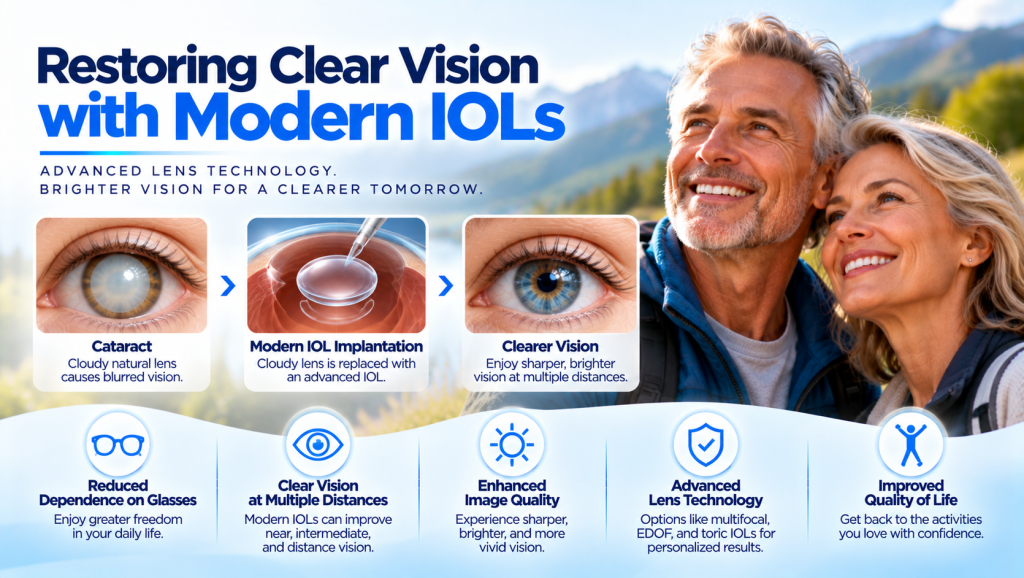
An intraocular lens (IOL) is a tiny, artificial lens implanted in the eye to replace the natural lens when it becomes cloudy from cataracts. The natural lens, made of clear protein and water, bends light to focus on the retina; when cataracts develop, proteins clump together and cloud the lens, blocking light and causing blurry vision, dull colors, and difficulty seeing in low light.
Nearly 4 million Americans undergo cataract surgery each year, making it one of the most common and safest outpatient procedures in the United States. During the surgery, which typically takes less than 30 minutes, the cloudy lens is removed through a tiny incision and replaced with a folded IOL that unfolds inside the eye. Most patients go home the same day and notice brighter, more vibrant colors soon after.
Modern IOLs do far more than just restore vision lost to cataracts. Depending on the type selected, they can also correct common refractive errors such as nearsightedness, farsightedness, and astigmatism, and reduce or eliminate the need for glasses after surgery. At Diamond Vision, patients receive personalized guidance from experienced ophthalmologists to choose an IOL that aligns with their daily activities and vision goals.
Which intraocular lens (IOL) is right for you ?
Main Types of Intraocular Lenses Explained
The type of intraocular lens (IOL) you choose determines how you see after cataract surgery and how much you may still rely on glasses. Below is a breakdown of the main categories available today.
Monofocal IOLs. These are the most common and widely covered by insurance. They provide clear vision at a single distance, usually set for distance vision, which means you will likely need reading glasses for close tasks. They do not correct astigmatism.Multifocal IOLs. These lenses have multiple corrective zones, like bifocal or trifocal glasses, so they can help you see clearly at near, intermediate, and far distances. They can reduce or eliminate the need for glasses but may cause some glare or halos around lights at night.Extended Depth-of-Focus (EDOF) IOLs. EDOF lenses use a single elongated corrective zone to deliver a continuous range of clear vision from distance through intermediate. They are an excellent choice for computer work and driving, and they typically cause fewer visual side effects than multifocals, though most patients still need reading glasses for very close-up tasks.Accommodative IOLs. These lenses are designed to shift or change shape slightly inside the eye, using the natural muscles that originally focused the eye’s own lens. This can provide some focusing ability at different distances, though results vary and glasses may still be needed for prolonged near work.Light-Adjustable Lens (LAL). A newer type of monofocal IOL made from a photosensitive material. After your eye has healed from surgery, your ophthalmologist can use precise UV light treatments in the office to fine-tune the lens power, correcting any residual refractive error, including astigmatism. This allows a highly customized result.Toric IOLs. Toric lenses are specially designed to correct astigmatism, an irregular curvature of the cornea. They are available in monofocal, multifocal, and EDOF designs, so you can address astigmatism while also choosing your desired range of vision. Proper alignment during surgery is critical for their effectiveness.
Each IOL type has unique strengths and trade-offs. The right choice depends on your daily activities (reading, computer use, night driving), any eye conditions you may have, and whether you are comfortable wearing glasses for some tasks. During a consultation, the team at diamondvision.com can review your specific eye measurements and lifestyle needs to help you select the best option for lasting clarity.
Which Lens Is Most Advanced?
No single intraocular lens is the “most advanced” for every patient, but premium presbyopia-correcting IOLs represent the current forefront of cataract surgery technology. These lenses are designed to reduce dependence on glasses by providing clear vision at multiple distances, a significant step beyond standard monofocal lenses. Our board-certified surgeons at Diamond Vision have extensive experience with these advanced lenses, ensuring you receive expert care.
Multifocal and Extended Depth-of-Focus (EDOF) IOLs
Multifocal IOLs use concentric rings to divide light into multiple focal points, allowing many patients to see clearly at near, intermediate, and far distances without glasses. Extended depth-of-focus (EDOF) lenses, such as the Alcon Vivity, stretch a single corrective zone to provide excellent distance and intermediate vision while typically causing fewer visual side effects like halos and glare compared to traditional multifocals. At Diamond Vision, your surgeon can discuss whether a multifocal or EDOF lens aligns with your daily activities and visual priorities.
Light-Adjustable Lens (LAL) and Toric IOLs
The light-adjustable lens (LAL) is a cutting-edge monofocal IOL made from a photosensitive material. After surgery, the ophthalmologist can fine-tune its power using non-invasive UV light treatments, allowing customized vision correction for distance, near, or monovision based on real-world results. For patients with astigmatism, toric IOLs provide advanced correction by compensating for the eye’s irregular corneal curvature. Toric designs are available in monofocal, multifocal, and EDOF versions, giving patients flexibility in choosing their preferred vision range. Diamond Vision offers a full range of these advanced options, with your consultation determining the best fit for your eye health and lifestyle goals. We also provide flexible financing options and comprehensive warranty plans to make your procedure accessible and worry-free.
Choosing the Best IOL for Your Lifestyle
Selecting the right intraocular lens (IOL) is not only about your eye health but also about how you want to see the world every day. Start with a focused conversation with your ophthalmologist about your daily routines, from reading and computer use to driving at night. Each IOL type offers a different balance between visual freedom and potential side effects, and the best choice depends on your personal priorities.
For many people, a standard monofocal IOL provides excellent distance vision at no extra cost, as it is fully covered by Medicare and most insurance plans. You will likely need glasses for reading or close work. If you want to reduce your dependence on glasses, premium lenses such as multifocal, extended depth-of-focus (EDOF), or toric IOLs can correct multiple distances or astigmatism, but they require an out-of-pocket investment.
Night drivers and those sensitive to glare or halos around lights should consider how each lens type affects nighttime vision. Monofocal and some EDOF lenses produce fewer visual disturbances, while multifocal IOLs may cause more glare initially. A toric IOL is usually the best option if you have moderate to high astigmatism, as it can sharpen vision without the side effects of a multifocal design.
At Diamond Vision, your consultation is the cornerstone of this process. Your surgeon will evaluate your eye measurements and vision goals, review the costs and benefits of each premium option, and help you weigh trade-offs like reading glasses versus night vision quality. A free consultation ensures you receive a personalized recommendation that matches your lifestyle and budget.
| Lens Type | Best For | Out-of-Pocket Cost | Night Vision Impact |
| Monofocal | Distance vision; okay with reading glasses | Covered by insurance | Low risk of glare/halos |
| Multifocal / Trifocal | Minimal glasses for all distances | $2,000 – $2,600 per eye | Possible halos/glare (often fades) |
| Extended Depth-of-Focus (EDOF) | Distance + intermediate vision; computer work | $2,000 – $2,600 per eye | Lower disturbance than multifocal |
| Toric | Astigmatism correction (all types) | ~$1,000 per eye | Depends on lens design |
What Doctors Typically Recommend
While there is no single “best” lens for every patient, most ophthalmologists consider monofocal intraocular lenses (IOLs) the standard recommendation due to their proven reliability and excellent visual outcomes at a single distance, typically set for far vision. These lenses have been the most commonly used for decades and are generally covered by Medicare and insurance, making them the most accessible and predictable option for the majority of patients.
For patients with astigmatism, doctors frequently recommend toric monofocal lenses to correct the irregular corneal shape and improve distance vision. The American Academy of Ophthalmology notes that people with moderate to high astigmatism are usually happier with toric IOLs.
However, the “most recommended” lens ultimately depends on individual lifestyle and visual needs. Many specialists now suggest premium lenses such as multifocal or extended depth-of-focus IOLs for patients who want to reduce their dependence on glasses for near and intermediate tasks. At Diamond Vision, your ophthalmologist will conduct a thorough evaluation to help you select the lens that best aligns with your vision goals, budget, and daily activities.
Best Lens for Astigmatism and Night Driving
For patients with astigmatism, the best choice is a toric intraocular lens (IOL). These lenses are specifically designed to correct the irregular curvature of the cornea, which causes blurred vision. They compensate for the eye’s football-like shape to focus light properly on the retina, delivering sharp distance vision. Toric IOLs are available in both monofocal and premium presbyopia-correcting versions, giving you the option to also address age-related farsightedness.
During surgery, precise alignment markers on the toric lens ensure accurate placement to minimize residual astigmatism. At Diamond Vision, our ophthalmologists use advanced corneal mapping technology to determine your specific astigmatism type and recommend the most effective toric lens for your needs. The lens is rotated to match your eye’s individual axis, often reducing astigmatism to 0.5 diopters or less for excellent visual clarity.
When night driving is a priority, a monofocal IOL is typically the best option. Monofocal lenses provide the clearest distance vision with the fewest visual disturbances — such as halos, glare, or starbursts around headlights. Premium multifocal or extended depth-of-focus lenses are more likely to cause these nighttime artifacts. However, they also offer the convenience of vision at multiple distances without glasses. Your choice depends on your personal tolerance for these effects.
A thorough discussion with your ophthalmologist about your driving habits and lifestyle is essential. They can guide you to the lens that balances your need for clear night vision with your overall visual goals.
Premium IOLs: Costs and Coverage
When choosing an intraocular lens (IOL) for cataract surgery, the type of lens directly affects your final bill. Standard monofocal IOLs, which provide clear vision at a single distance, are fully covered by Medicare and most private insurance plans. Premium IOLs — including multifocal, EDOF, toric, accommodative, and light-adjustable lenses (LAL) — offer reduced dependence on glasses but come with additional out-of-pocket costs.
According to Duke Health, out-of-pocket expenses for premium IOLs typically range from about $1,000 per eye for a toric lens to 2,000–2,600 per eye for a presbyopia-correcting lens. Other sources indicate that costs can reach $4,000 or more per eye depending on the specific lens technology and your location. The base cataract surgery itself averages 3,000–6,000 per eye, so selecting a premium lens significantly increases your total investment.
At diamondvision.com, our experienced ophthalmologists help you compare these costs against your lifestyle needs. For example, if you prioritize night driving without glare, an EDOF or monofocal IOL may be more suitable than a multifocal, which can cause halos around lights. We provide transparent pricing for premium IOLs and discuss financing options that can make advanced lens technology more accessible.
Many patients use Health Savings Accounts (HSA) or Flexible Spending Accounts (FSA) to cover premium IOL costs. Some practices also offer payment plans or third-party financing to spread the expense over time. During your consultation, ask about the total cost — including any additional fees for laser-assisted surgery or advanced diagnostics — so you can budget accurately and choose the lens that best fits your vision goals and financial situation.
Lens Longevity, Brands, and Mixing Lenses
Intraocular lenses (IOLs) are designed to last a lifetime. Made from biocompatible materials such as acrylic or silicone, these lenses do not break down or wear out over time. The new lens is held securely in place by the eye’s natural lens capsule, which is left intact during surgery to serve as a permanent supportive pocket.
In some cases, the capsule behind the implant may cloud up months or years later—a condition called posterior capsular opacification, or secondary cataract. However, this is not a failure of the lens itself and can be treated easily with a quick, in-office laser procedure. With proper care, your IOL should provide clear vision for the rest of your life.
Leading IOL Brands
The three leading IOL manufacturers are Alcon (which produces the Clareon Vivity and PanOptix lines), Johnson & Johnson Vision (maker of the TECNIS Synergy and PureSee), and Bausch + Lomb (known for the Envista Envy). There is no single “best” brand. The ideal choice depends on your lifestyle, visual needs, and budget. For example, the Alcon Vivity offers excellent intermediate and distance vision with minimal glare, while the TECNIS Synergy provides strong near-to-distance clarity. For patients with astigmatism, toric versions of these lenses add extra correction. At Diamond Vision, our ophthalmologists evaluate your eyes and daily activities to recommend the right IOL for you.
Mix-and-Match Strategy
It is possible to have different types of IOLs in each eye, a strategy known as “blended vision” or mix-and-match. For example, a surgeon might implant a monofocal lens set for distance in one eye and a multifocal or near-vision lens in the other. This customized approach can reduce glasses dependence across a wider range of activities while maintaining excellent visual outcomes. A thorough consultation with your ophthalmologist is essential to determine the best strategy for your specific needs and to ensure realistic expectations.
Make an Informed Choice with Expert Guidance
Choosing an intraocular lens is a deeply personal decision, shaped by how you live, work, and see the world. No single IOL is right for everyone. The goal is to find a lens that aligns with your vision priorities, daily activities, and comfort with visual trade-offs like nighttime halos or the need for reading glasses.
A thorough consultation with an experienced ophthalmologist is the most important step. Your surgeon will evaluate your eye shape, corneal curvature, and any existing conditions such as astigmatism or macular degeneration. They will also discuss lifestyle factors, including driving habits, computer use, and hobbies like golf or knitting, to help match your goals to the right technology.
At Diamond Vision, patients receive personalized care and access to a broad range of advanced IOL options, including monofocal, toric, multifocal, EDOF, and light-adjustable lenses. Whether you prioritize clear distance vision, reduced dependence on glasses, or correction for astigmatism and night driving, Diamond Vision’s specialists help guide the decision with clarity and expertise.
The final step is scheduling a free consultation. During this visit, your surgeon will answer your questions, demonstrate how different IOLs could affect your vision, and outline any out-of-pocket costs for premium upgrades. With the right information and expert support, you can move forward with confidence.
Contact Us
If you have more questions about LASIK procedures, get in touch with us.
Related Blogs

Understanding Your Vision Needs During Middle Age
As you enter your 40s, the natural aging process begins to affect the eye’s internal lens, which gradually loses the flexibility required to focus on
Embracing Innovation for Better Vision
Modern eye care is undergoing a significant transformation as digital tools and diagnostic accuracy redefine patient outcomes. Innovations like WaveLight® Plus allow surgeons to create
Restoring Clear Vision with Modern IOLs
An intraocular lens (IOL) is a tiny, artificial lens implanted in the eye to replace the natural lens when it becomes cloudy from cataracts. The
