
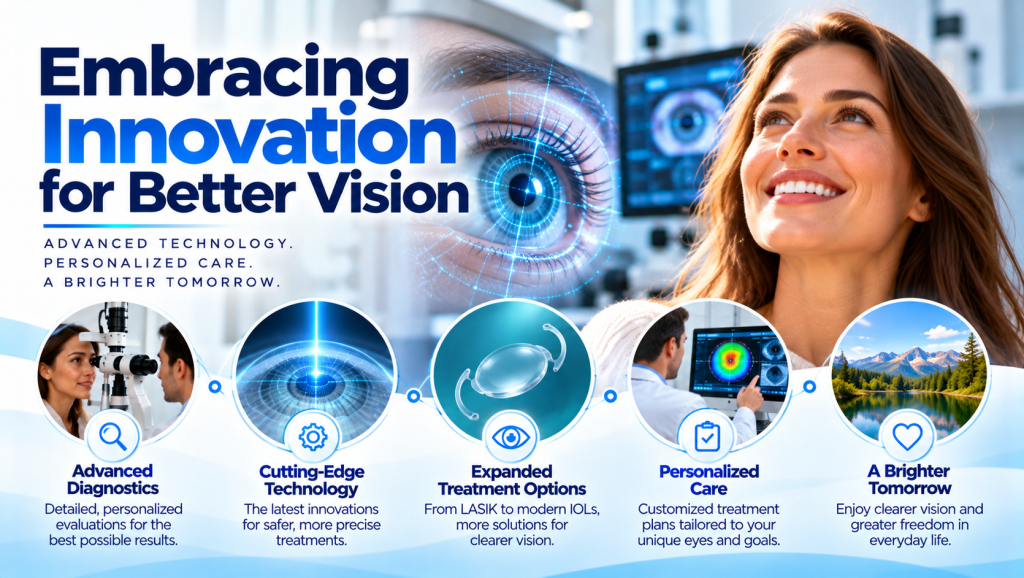
Modern eye care is undergoing a significant transformation as digital tools and diagnostic accuracy redefine patient outcomes. Innovations like WaveLight® Plus allow surgeons to create highly personalized treatment plans based on a 3D digital model of the eye. This level of precision is increasingly vital for achieving vision quality that exceeds traditional standards.
At diamondvision.com, we pair these advanced diagnostic systems with expert clinical care. While some clinics rely on standard methods, our use of detailed digital eye mapping ensures every patient receives a customized procedure tailored to their unique anatomy. By integrating AI-driven laser technology, we deliver outcomes that prioritize long-term safety and visual clarity.
AI in Ophthalmology: Transforming Eye Care | Dr. Vivek Explains
AI-Driven Laser Surgery: The New Standard
The landscape of vision correction is undergoing a definitive shift toward extreme personalization, moving well beyond traditional refractive standards. Recent advancements in laser eye surgery, such as WaveLight® Plus, are setting new benchmarks for precision by utilizing artificial intelligence and ray-tracing technology to map the eye in unprecedented detail. While some surgical approaches rely on generic prescriptions, diamondvision.com leverages this ray-tracing guided platform to create a 3D digital twin of the patient eye, known as an eyevatar.
This process involves capturing over 100,000 unique data points per eye, allowing surgeons to account for microscopic irregularities that standard methods might overlook. A study presented at the American Academy of Ophthalmology found that this level of data-driven planning leads to superior outcomes compared to other refractive surgery options. Where traditional procedures aim for 20/20 vision, this technology often enables patients to achieve 20/12.5 vision or better.
Beyond raw visual acuity, the technology excels at enhancing overall visual quality. By addressing higher-order aberrations, the system can significantly reduce common patient complaints such as glare, halos, and poor contrast sensitivity. It may also offer superior astigmatism correction, providing sharper vision during night-time driving and other low-light conditions. At diamondvision.com, our expert ophthalmologists use these tools to create tailored treatment plans that prioritize both safety and long-term clarity. We invite you to schedule a free consultation to discuss whether these state-of-the-art diagnostic and surgical technologies are the right fit for your vision goals.
Who Should Consider Alternatives to LASIK?
While many people benefit from laser eye surgery, certain factors may make an individual unsuitable for these procedures. Potential candidates are often disqualified if they have thin or irregular corneas, severe dry eye syndrome, or uncontrolled medical conditions like diabetes, which can impact corneal healing. Other contraindications include certain autoimmune diseases, immunodeficiency states, or the use of specific medications that might interfere with proper recovery.
At diamondvision.com, our board-certified ophthalmologists prioritize patient safety by requiring a comprehensive evaluation before any procedure. This assessment is critical for those experiencing refractive instability, defined as a notable change in a prescription within the last year, or individuals who are currently pregnant or breastfeeding. While these factors may rule out traditional LASIK, our experts can often identify viable paths forward through alternative options like the EVO ICL.
Unlike some practices that rely on standardized screening, diamondvision.com utilizes advanced digital mapping and wavefront technology to evaluate every patient’s unique ocular structure. By gathering precise data on corneal thickness and surface regularity, we can confirm if you are an ideal candidate for vision correction or if you require an alternative approach. We encourage you to schedule a free consultation with our team to discuss your medical history and determine which pathway best supports your long-term vision goals.
Permanent Results and Alternative Paths
Laser eye surgery serves as a foundational step toward long-term visual freedom. The LASIK procedure permanently reshapes the corneal tissue, providing a lasting correction for common refractive errors such as nearsightedness, farsightedness, and astigmatism. By utilizing advanced diagnostics like digital corneal mapping, our surgeons ensure that the tissue removal is precisely calibrated to the unique contours of your eye.
While the physical changes to the cornea are permanent, it is important to understand that these procedures do not halt natural, age-related changes within the eye. Over time, factors such as the onset of presbyopia or the eventual development of cataracts may still occur, as these involve the eye’s internal lens rather than the surface. Competitors may offer generic refractive services, but at diamondvision.com, we prioritize comprehensive evaluations that account for both your current anatomy and your long-term visual health.
Not every patient is a candidate for LASIK, particularly those with thin corneas, high refractive errors, or underlying ocular conditions. For these individuals, we often recommend EVO ICL (Implantable Collamer Lens) or Photorefractive Keratectomy (PRK). Unlike LASIK, which relies on a corneal flap, the ICL is a reversible, collagen-copolymer lens implanted behind the iris. This provides a specialized alternative for patients who require more robust correction or have anatomical features that make traditional laser surgery less suitable.
Choosing between these paths requires a detailed analysis of your personal lifestyle and diagnostic data. We encourage you to schedule a free consultation with our experienced team to review your scans and identify whether LASIK, PRK, or an ICL procedure offers the most predictable outcome for your vision goals.
Investing in Your Vision: Costs and Financing
What should patients consider regarding the cost and financing of laser eye surgery? The final price of your procedure varies significantly based on the specific advanced technology required and the unique complexity of your vision correction needs. While the upfront investment is a primary consideration for many, it is productive to view the procedure as a strategic long-term financial decision. For most individuals, the one-time cost is substantially lower than the cumulative expense of a lifetime spent purchasing glasses, contact lenses, and their associated care supplies.
Because standard insurance providers typically classify procedures like LASIK as elective, full coverage is rare. However, we always recommend that patients confirm their specific benefits, as some carriers offer negotiated discounts or partial coverage for vision correction. To ensure that high-quality surgical care remains accessible, Diamond Vision provides a variety of flexible financing options. Our team works with patients to identify specialized programs that break down the total investment into comfortable, manageable monthly payments.
Every patient anatomy is distinct, and a personalized assessment is necessary to determine the exact resources needed for your procedure. We invite you to schedule a free consultation with our experienced team at Diamond Vision to receive a comprehensive, personalized quote. During this session, you will learn about the precise technology that will be used to correct your vision and how our financial plans can be tailored to your specific budget, putting your goal of long-term visual freedom within reach.
The Power of Advanced Diagnostics
Modern eye care relies on sophisticated diagnostic technology to build a precise understanding of your unique ocular health. At diamondvision.com, these tools form the foundation of every personalized surgical plan, ensuring that our ophthalmologists can address your specific needs with high accuracy. While traditional screenings often catch only broad issues, advanced diagnostic platforms allow us to map the eye’s surface and internal structures in incredible detail.
A key component of this assessment is Optomap retinal imaging, which captures up to 80% of the retinal tissue in one painless, rapid image. This wide-angle view helps clinicians spot systemic health concerns early. Complementing this is Optical Coherence Tomography (OCT), a high-resolution imaging technique that provides cross-sectional views of the retina, allowing for precise monitoring of layers for conditions such as glaucoma.
Corneal Topography. This technology maps the surface of the cornea in three dimensions to detect irregularities. By understanding your eye’s unique curvature, we can customize treatments beyond what standard prescriptions offer.Wavefront Aberrometry. This process measures how light travels through your eye to identify microscopic imperfections. By addressing these specific aberrations, we can improve your overall visual quality and reduce issues like glare or halos.Digital Refraction. Automated phoropters and digital systems replace manual methods to determine your refractive prescription with extreme efficiency, ensuring the final measurement is precise and comfortable.
By integrating these diagnostic data points, diamondvision.com creates a digital eye mapping profile for every patient. This rigorous approach minimizes guesswork and supports long-term outcomes. If you are interested in how these diagnostics can refine your path to clearer vision, we invite you to book a free consultation to discuss your candidacy.
Artificial Intelligence in Eye Care
Artificial intelligence is fundamentally reshaping how eye conditions are diagnosed and managed by providing practitioners with tools that enhance clinical precision. Sophisticated algorithms can now detect markers for diabetic retinopathy, glaucoma, and age-related macular degeneration (AMD) with expert-level accuracy. At diamondvision.com, we leverage these innovations to refine our diagnostic protocols and ensure every surgical candidate receives the most accurate assessment possible.
Specific FDA-cleared devices like LumineticsCore have standardized the early detection of diabetic retinopathy, while home-based platforms like the ForeseeHome AMD Monitoring Program and the iCare Home tonometer allow patients to track their health remotely. These technologies expand access to care through telemedicine and remote screening, which are vital for reaching patients in underserved areas.
- Data privacy and the protection of sensitive patient information remain a top priority as digital integration grows.
- Regulatory standards are evolving to ensure that AI tools maintain the same quality of care as traditional in-person examinations.
- The human-in-the-loop requirement ensures that clinicians remain the final authority on all diagnostic decisions and treatment plans.
While global health programs prioritize these tools to improve universal eye health, the focus at diamondvision.com remains on combining this automated efficiency with the personalized care of our experienced ophthalmologists. This hybrid approach allows us to utilize the speed of digital diagnostics while maintaining the physical patient-clinician interaction essential for successful surgical outcomes.
Future Frontiers: Smart Lenses and Virtual Reality
The evolution of eye care now reaches into the digital future through the development of smart contact lenses. These emerging tools are designed for medical applications, such as controlled drug delivery or biosensing to monitor glucose levels or glaucoma biomarkers. While recreational smart lenses featuring MicroLED displays are also in development, these technologies require professional oversight to ensure ocular safety and health.
Virtual and augmented reality are fundamentally changing how vision is treated and how surgeons are trained. These technologies are increasingly used in vision therapy to treat conditions like amblyopia, strabismus, and general visual efficiency. Similarly, surgical simulators such as Eyesi and the Eye Surgery Simulator provide risk-free, immersive environments for trainees to hone their technical proficiency before moving to the operating room.
Despite these advancements, the role of the clinician remains vital. The American Optometric Association highlights that excessive use of these devices can contribute to ocular surface issues or myopia progression. At diamondvision.com, our specialists emphasize that while digital tools support our outcomes, personalized care is essential to navigate these emerging solutions safely. We invite patients to schedule a free consultation to discuss how the latest innovations, from digital eye mapping to modern refractive options, can support their specific vision goals.
Comprehensive Exams: Where Technology Meets Precision
Modern eye care distinguishes clearly between preliminary digital vision screeners and comprehensive eye exams. While screeners offer a quick snapshot of refractive needs, a comprehensive exam at diamondvision.com utilizes advanced diagnostic tools to perform a full health assessment. By integrating Optical Coherence Tomography (OCT) and high-resolution retinal imaging, clinicians can capture detailed cross-sectional views of the retina to monitor for conditions like glaucoma and macular degeneration with high precision.
Precision starts with how your prescription is determined. Automated refractors and keratometers eliminate the margin of error present in manual methods, providing consistent data for eyeglasses and contact lenses. Unlike basic screening tools, these technologies map the unique surface of the cornea, a standard practice for personalized surgical planning used by our ophthalmologists.
Regular screenings also serve as a vital window into your general health. Tonometry for measuring intraocular pressure is a critical step in managing ocular hypertension, which can often be detected long before a patient notices vision loss. Beyond the eye itself, these detailed exams help identify early markers of systemic diseases such as hypertension and diabetes, reinforcing the role of the comprehensive eye exam as a fundamental component of your long-term wellness strategy.
Your Path to Clearer Vision
Modern eye care integrates advanced diagnostics and precision surgical tools to elevate patient outcomes. At diamondvision.com, we prioritize this technological foundation by combining digital eye mapping with the expertise of our surgeons to create highly personalized treatment plans.
While generic providers may offer standard solutions, our practice utilizes AI-powered systems to tailor every step of your procedure. This commitment ensures that each patient receives care designed specifically for their unique ocular anatomy.
Are you ready to see the difference technology makes? We invite you to schedule a free consultation with our team at diamondvision.com to determine how these innovations can help you achieve your vision goals.
Contact Us
If you have more questions about LASIK procedures, get in touch with us.
Related Blogs

Understanding Your Vision Needs During Middle Age
As you enter your 40s, the natural aging process begins to affect the eye’s internal lens, which gradually loses the flexibility required to focus on
Embracing Innovation for Better Vision
Modern eye care is undergoing a significant transformation as digital tools and diagnostic accuracy redefine patient outcomes. Innovations like WaveLight® Plus allow surgeons to create

Restoring Clear Vision with Modern IOLs
An intraocular lens (IOL) is a tiny, artificial lens implanted in the eye to replace the natural lens when it becomes cloudy from cataracts. The
